Saturday, March 12, 2016

Filmmaker in Search of Her Subject - visit to northern coastal Peru #1

part #1:

In addition to my two or so weeks in Lima, and my travels to the south, principally to the town of el Carmen, center of Afro-Peruvian culture, I went up north to visit the town of Zaña and the region around it.  This, like the rest of my time in Peru, was for the purpose of learning more about Afro-Peruvian culture, especially its music and dance, because Zaña is home to the important Afro-Peruvian museum.

Zaña is in the coastal region of Peru, near the small city of Lambayeque.  To get there, once again I took a bus-cama, leaving Lima in the late afternoon and arriving in Lambayeque in the morning of the following day.  From Lambayeque, I took a licensed cab to get to Zaña.


The museum is a re-creation in miniature of what archaeologists believe the pyramids looked like at the time the ruler was buried.  The "good stuff" is down in a deep basement, again representing the archaeological site.

On the way, however, I decided to make a stop at a place unrelated to my work:  the museum which houses most of the collection taken from the pyramid and tomb of el Señor de Sipan.

Who is this Señor de Sipan, you ask.

Glad you brought it up.  Peru, in addition to being the home of the Incas, was home to several other important civilizations.  One of these was the Sipán, or Moche, who actually pre-dated the Incas.  The civilization flourished from about 50-700AD, while the Inca rule only began in 1438, and ended less than 100 years later, in 1533.

The later rules of Sipán were mummified and buried in pyramids, and a few decades ago, in the later 1980s, a grouping of three of these pyramids were discovered and explored.

The pyramids now looks like a large, bare hills.  They were made of adobe bricks, and over the centuries, the rains have eaten away at it.  This is one of the reasons they were only recently discovered.


replica of one of the many adornments found on the mummy of the Señor de Sipán:  gold necklace and earrings with owl heads;  the owl represents the afterlife

Excavations of the second to largest of these pyramids revealed the elaborate tomb and mummy of what is presumed to have been a great ruler, now referred to as el Señor de Sipán (the Lord of Sipán).

The museum contains a replica of the mummy of the ruler, his wife, and someone important who was buried under him (possibly his father) while the actual remains have been left in the pyramid (which I didn't have time to visit).  The display in the museum shows what the burial chamber looks like, and has many of the fabulous gold, silver, turquoise, and other jewelry with which he and his wife were adorned.

Of course, a couple of guards, dogs, and other former beings were buried along with them, presumably to wait on them, keep them company in the afterlife, and so forth.

_________________
Eve A. Ma, a former university professor, lawyer, and director of a non-profit cultural organization, is the producer-director of two documentaries about Afro-Peruvians:  A Zest for Life and Masters of Rhythm with addendum.  Sign up for her newsletter to keep up with her work and get a special video:  www.PalominoPro-signup.com

Saturday, March 5, 2016

Is the sky falling? Or is flamenco in danger of dying?

Is the sky falling?  Or is flamenco in danger of dying?

(We will continue next week with the series on my trip to Peru.)


Over the past several months, I've slowly been reading Sinalo Calorró by Juan Manuel Suarez Japón, a biography of Manuel Morao which traces Manuel Morao's life in flamenco through the author's conversations with him.  One fascinating thing is that, back in the 1960s when everyone else thought flamenco was flourishing, Manuel Morao felt it was in danger of disappearing.  I think Manuel Morao was right.


Manuel Morao in front of the Plaza de Toros,
where the Jueves Flamencos were held

But who is Manuel Morao, why does his opinion carry any weight, and why did he think traditional flamenco was in trouble?

Click on LINK to hear Manuel Morao playing solo guitar.  And since playing solo isn't usual, here he is accompanying the singing - cante - of Antonio Mairena.  LINK

First, who is he:  from the 1960s through the early 1990s, he was one of the pre-eminent flamenco guitarists, and toured throughout Europe and North America.  He was also the favorite accompanist of Antonio Mairena and Terremoto the elder, to say nothing of la Paquiera, Chocolate, and many others.  Furthermore, he greatly influenced his guitarist nephew, Moraito, plus his guitarist grand-nephew, Diego del Morao.


Manuel Morao with Antonio de la Malena

He helped organize and record major anthologies with Antonio Mairena and others, in which he was also principal guitarist.  He is one of the main guitarists in the famous video series, Rito y Geografía del Cante.

In the mid-1970s, he stepped back from much of his touring and most of his recording to return to his birthplace, Jerez de la Frontera, where he became a major promoter of flamenco.  He organized - and played for - a weekly series of extremely popular events in Jerez called "Jueves Flamencos" (Flamenco Thursdays), which he ran for years and which launched the careers of many of the famous performers of today (including that of Antonio de la Malena).

That, however, was not enough.  In the early 1990s, he started a company called Gitanos de Jerez (Gypsies of Jerez) which produced music albums, DVDs, and major shows.  The most famous show was one in which he brought 22 flamenco artists to play on Broadway in something called "Gitanos:  Esa Forma de Vivir" ("Gypsy Passion").


preparing to film interview with Manuel Morao


Gitanos de Jerez continued in operation, very successfully, until the early 2000s.  By this time, Manuel Morao had stopped playing the guitar, partly because he had developed a nerve problem in his hands.

But why did this man believe, even back in the 1960s, that flamenco was in danger of disappearing - something he spent his entire life and career trying to prevent?  For Manuel Morao, "flamenco" was another word for "el cante de los gitanos," which literally means "the singing of the Gypsies [of Andalucía in southern Spain]" but practically, means traditional flamenco.


preparing to film in another location;  Manuel Morao is on the sofa

His emphasis on gitanos - the Gypsies of Andalucía - does not mean he believes only gitanos can sing and perform flamenco;  but he does fervently believe that the art comes from them, they are its purest proponents, and the art continues to be part of their heritage,  an integral part of their community.

To learn the danger in which traditional flamenco finds itself, you will need to watch the documentary we are making, Flamenco:  the Land Is Still Fertile (Flamenco:  la tierra está viva).  Go HERE to check out its web site.

_________________

Eve A. Ma, a former university professor, lawyer, and director of a non-profit cultural organization, is the producer-director of several documentaries about world music and dance, including A Zest for LifeAfro-Peruvian Rhythms Of Beauty & Deities:  Music & Dance of India, and Masters of Rhythm with addendum.  Sign up for her newsletter to keep up with her work and get a special video:  www.PalominoPro-signup.com

Tuesday, March 1, 2016

Filmmaker in Search of Her Subject - visit to southern coastal Peru #3

part 3:

As promised:


Here is a video about the "hatajos" with an explanation of them.

When it came time to leave el Carmen, I encountered the problem of paying my bill at the lovely bed and breakfast.  The owner needed cash.  I didn’t have enough cash – and the ATM in the local grocery store wouldn’t accept my (foreign) ATM card.

SO – we went to Chincha for lunch to allow me to visit a bank with an ATM that would accept my card.  To get to Chincha, we took a local bus – crowded, bumpy, but friendly.   It made me feel a little less like an outsider, even though in fact I was one.

After I paid my bill and left el Carmen, I went to the town of San Luis de Cañete for a few hours to film the kids that my friend (and star of my documentary) Lalo Izquierdo teaches in a cultural center he helps operate.  San Luis de Cañete is another center of Afro-Peruvian culture.  Unfortunately, I wasn't able to take any photos in San Luis:  too little light, and I was busy filming.

Because I arrived several hours late, we went straight to the place where I was to film, which was where the kids were rehearsing for THEIR “hatajos.”  The rehearsal space was in a building with no roof! 

The kids were great, but later, to get signatures giving me permission to use what I had shot, I had to pay the parents.  I was not expecting this and it was not in my budget.  As a result,   I’ve only been able to pay to use a very small number of these kids.   What a shame!

a jitney just like the one I took in San Luis de Cañete

In San Luis de Cañete, I also had my first ride in a jitney (a covered, three-wheeled motorcycle that is used as a taxi in many Peruvian towns).  Kind of fun, but I’m not sure you’d stay very dry if it were raining.   And after the filming, we had dinner in a little, local restaurant beside the Pan-American highway, hanging out there until my bus back to Lima arrived.

Once again, another bus-cama.

My last article about my Peruvian trip, will cover my trip to the town of Zaña in the north, with a brief stop at the museum of the Señor del Sipán, dedicated to displaying some impressive artifacts obtained from the pyramids of one of Peru’s ancient civilizations.

_________________
Eve A. Ma, a former university professor, lawyer, and director of a non-profit cultural organization, is the producer-director of two documentaries about Afro-Peruvians:  A Zest for Life and Masters of Rhythm with addendum.  Sign up for her newsletter to keep up with her work and get a special video:  www.PalominoPro-signup.com

Saturday, February 27, 2016

Filmmaker in Search of Her Subject - visit to southern coastal Peru #2

part 2

As I’ve mentioned, el Carmen (and indeed, much of the region of Chincha) is known as a center of Afro-Peruvian culture.  El Carmen and the nearby towns of San José, Guayabo and others maintain a very old Afro-Peruvian tradition called the “hatajos de negritos.” 

This is a kind of performance and procession that is part of the Christmas celebration, and also the celebration of the Virgin of el Carmen, whose special day is December 28.  I’ll add a video of the celebration later on in this article. 


the front drive to the bed and breakfast:  Huaranjapo


But first, I should tell you about the bed and breakfast where I stayed.  It is on an estate that is a five minute walk from town.  There is a lovely bungalow, and a couple of small, outlying buildings that serve as additional guest rooms when the bungalow is full.  There is a swimming pool.  There is a patio.  There are a couple of friendly dogs;  and a nice couple that live in a tiny house near the front gate and act as caretakers.  There is a small avocado orchard;  a small guava orchard;  a few banana trees;  a large lawn;  lots of flowers…in sum, a lovely place.  And yes, it has an internet connection.


Amerigo and his wife - the caretakers - in the back veranda of the main guest house

The only downside that I encountered was – mosquitoes.  Bring insect repellent.  Seriously.

one side of the main guest house

The owner, Edith Maldonado, is friendly and very well informed about Afro-Peruvian culture.  She is a pillar (and former board member) of one of the two cultural organizations in el Carmen.  We had been corresponding for months, and she introduced me to people in the town who helped me with my work.


Edith Maldonado (left) with board president Emely Villegas (right) in the cultural center
I was there to film the town (easy – it is a very small town) and the setting (lots of cotton fields, a river that I never got to, and other small towns nearby – I saw the town of San José very briefly).  I was also there to make contact with at least one cultural center;  and to film the rehearsals for the “hatajos de negritos.”

a street in the town - with the only two-storey building

the church dominates the town

there are lots of murals on the walls

The residents of the town are people of very modest means – so modest that I felt a little uncomfortable coming from the lovely bed and breakfast where I was staying to talk to people many of whose homes didn’t even have running water.

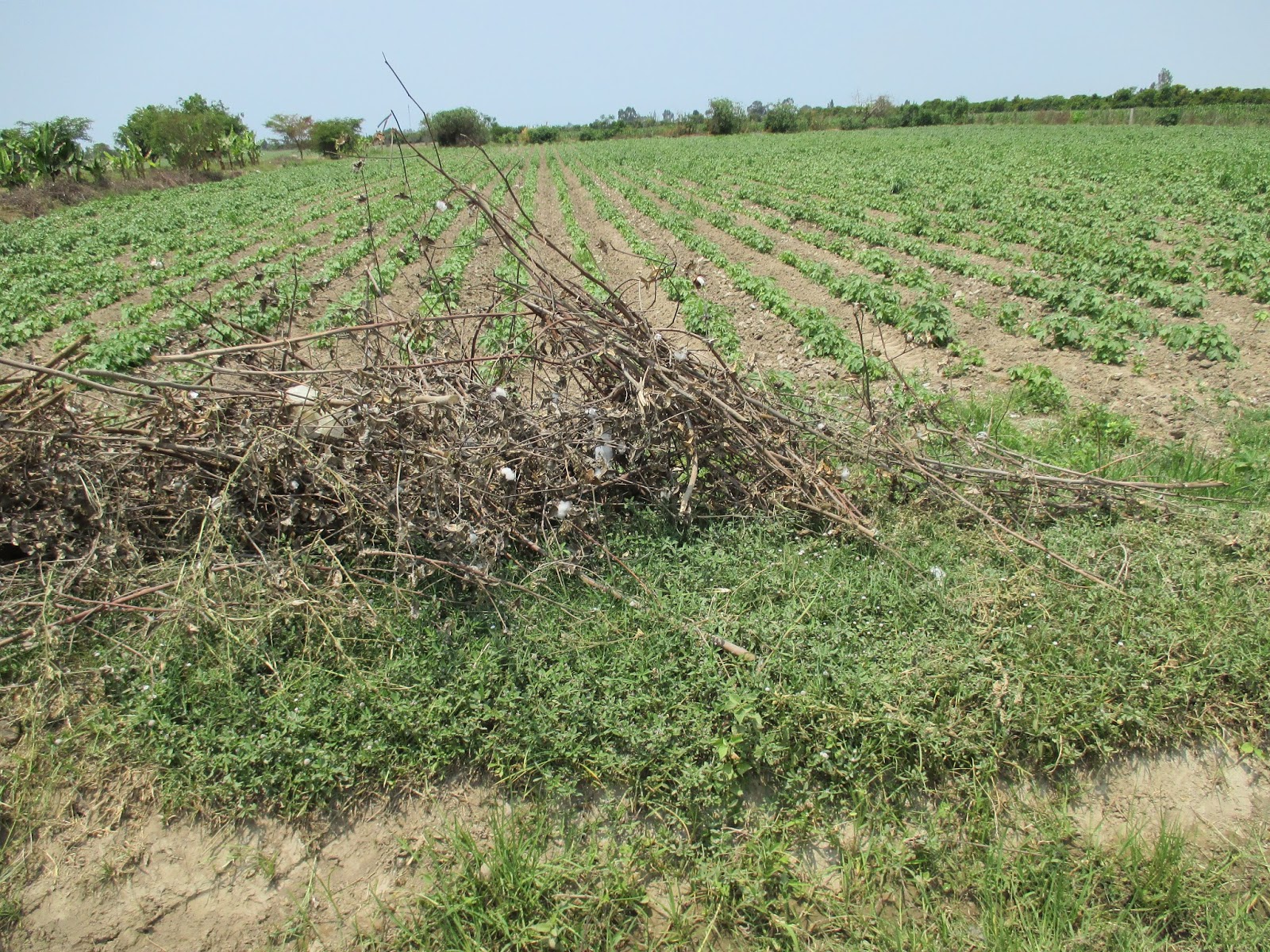
Although most own their own farmland, many find work outside of town in larger places like Chincha.  This is partly because a very few years ago, the Peruvian government signed a trade deal with China that has brought Chinese cotton into the country at a lower price than local cotton.  Some townspeople would like to change over to growing cacao, for which there is still a good market, but it takes three years for the cacao plants to mature enough to bring in a serious crop, and the townspeople don’t have the wherewithal to wait for three years with no farming income.

a cotton field outside of town

My filming of the town and of one rehearsal of the “hatajos” went pretty smoothly, although getting the required signature saying we’d filmed with permission turned out to be a bit sticky (but in the end, we got what I needed).   We also went to the home where the second group of “hatajos” rehearses, but they didn’t want to be filmed. 

house of Margarita Córdova where one set of "hatajos" rehearsed

I have since learned that “everyone” comes to el Carmen to see the “hatajos” – and many people have filmed them – so I guess people feel that they should get paid and that they are being somewhat taken advantage of.  I can sympathize with this.

I'll give you a video with clips of the "hatajos" and an explanation of them in the next post.

_________________
Eve A. Ma, a former university professor, lawyer, and director of a non-profit cultural organization, is the producer-director of two documentaries about Afro-Peruvians:  A Zest for Life and Masters of Rhythm with addendum.  Sign up for her newsletter to keep up with her work and get a special video:  www.PalominoPro-signup.com
Tuesday, February 23, 2016

Filmmaker in Search of Her Subject - visit to southern coastal Peru #1

In December of 2014, I spent about a month in Peru, shooting footage for documentaries about Afro-Peruvians.  About half of that time I was in Lima (see “Filmmaker in Search of Her Subject - My Trip to Lima, Peru).  The other half I spent in the coastal area to the north and south of Lima, in small towns known for being treasure troves of Afro-Peruvian culture.

No, the Andes Mountains and the ruins at Machu Picchu were not on my agenda;  I was working.

Lima is on the coast, about halfway down.  I was heading south.


In the south, I visited the town of el Carmen;  and in the north, the town of Zaña.  In this article, I’ll talk about going to the south, to el Carmen, and then San Luis de Cañete.

To get to el Carmen, I took a bus-cama (bus with beds).  A friend in Lima helped me purchase the ticket, which was a good thing because I certainly didn’t know my way around well enough to do so easily on my own.

The buses were overnight buses;  you could choose to leave any time from around 5pm up until around 8pm, all of which would put me at my destination in the morning.  A long trip.

I believe that somewhere on that bus-cama there were seats that could be stretched out into beds, but most passengers, myself included, had a seat in an area in which you could recline the seat somewhat, but certainly not enough to make it into a bed.

El Carmen is a little below the center of this map.

Dinner and breakfast were provided on the buses.  These meals were not anything memorable, so I’ll pass over them.  If you take one of these trips, consider bringing along your own food.

We traveled along the Pan-American highway which in most places is a two-lane highway with streets and roads crossing it. 

I had a window seat.  At the beginning of the trip, since the sun was up, I could look out.  For the first hour, what I saw was seemingly endless, poorer suburbs of Lima.  Then, we got to the countryside.

The river-valleys are full of small farms growing cotton and other crops.

The countryside was mostly dessert, with the ocean off on one side in the distance.   There were squatters’ shacks along part of this dessert area.  Then, almost without warning, we’d come to a lush river valley:  green, and full of trees, small farms, and towns.  I learned that Peru had had land-reform about 30 years ago, so that where once there were huge estates worked by day laborers or tenant farmers, now most of the farmers own their own land.

After a couple of hours on the bus-cama, it got dark.  Someone in corporate offices had had the unfortunate idea of installing a TV in the bus-camas and for some reason, the volume was turned up pretty loud.  It was impossible to ignore this machine once you couldn’t look out the window any more;  but finally, around 10:30pm, it went off. 

In the morning, I got off the bus-cama in a town called Chincha, and according to instructions (from the person who owned the bed and breakfast where I would stay), I took a licensed taxi to el Carmen.  The ride took about 15 minutes.

_________________
Eve A. Ma, a former university professor, lawyer, and director of a non-profit cultural organization, is the producer-director of two documentaries about Afro-Peruvians:  A Zest for Life and Masters of Rhythm with addendum.  Sign up for her newsletter to keep up with her work and get a special video:  www.PalominoPro-signup.com

Friday, February 19, 2016

Filmmaker in Search of Her Subject - My Trip to Lima, Peru - #2

(my trip to Lima, Peru - continued)

Before going, I’d made plans to meet with the people I was planning to film.  I’d also made contact with others who would provide me with information to deepen my awareness about Afro-Peruvian culture and its performance traditions.

On my first day after arriving, I did a lot of walking to see where I was located, and check out places to eat and purchase groceries.  I found that my apartment was near the lovely Parque Kennedy (Kennedy Park), as well as a supermarket (where I purchased an inexpensive cell phone), and a string of small bars where you could get a decent-to-good meal at a decent price.


Parque Kennedy
Bars along calle Berlin.

An aside here:  before going, I’d been told not to drink tap water or even the wonderful juices that are prepared with fruit pulp thinned by tap water.  Of course the first thing I did in the first little bar I went to was order one of those juices, completely forgetting the advice.  Halfway through, I remembered it and stopped drinking.  I suffered no ill effects and throughout my stay, gradually increased the amount of tap water I drank until I got to the point that I could forget the advice. 

Since different stomachs acculturate in different ways, my experience may or may not be what others will encounter.

On my second full day in Lima, I went to meet Lalo Izquierdo, one of the main subjects of both of the documentaries I was working on.  We arranged to meet in downtown Lima, in an area near the city center.  


Me with Lalo Izquierdo in the patio of the apartment where I was staying.
Rather than taking a taxi, I decided to take the bus.  There was a bus stop near my apartment and everyone was very helpful in advising me which bus to take.

But the line for my bus was, well, seemingly endless.  The buses themselves were very large, but still did not have nearly enough capacity for the number of people who wanted to get on.

A helpful gentleman told me that because of my obvious age (I’m well over 50), I could get at the head of the line.  Almost never in my life have I taken advantage, or wanted to take advantage, of my “senior” status, but one look at that line was enough to convince me it was time to make an exception.

When I got on the bus, there was no seating but since I don’t look frail, no one offered me a seat.  This was no problem;  I am in fact pretty sturdy.


Lots of people in a park for an event;  there were generally lots of people everywhere.
But the result of this bus ride, and the ride back (after having a pleasant and productive meeting with Lalo) was to clue me into something I continued noticing for much of my trip:  the infrastructure in Lima is overwhelmed by the population.  It is a city of a little over 7 million people, about a quarter of the population of the entire country, and a large percentage of these people have only moved into the city in the past one or two decades.

Other evidence of this was the sad state of much of the housing in the immense outlying districts.  I learned that there are a lot of squatters both in Lima and in the countryside who don’t have the means to build themselves good housing (or even to purchase any vacant land). 

In the countryside, I’ve been told that under certain circumstances you become the owner of land on which you have squatted (like the homesteading laws in the United States) but often, people build a very rudimentary house in, say, a semi-desert or desert area (there are huge stretches of desert along the coast of Peru) and then find it too difficult to live there, so they move along to another place, leaving the house – or shack – behind them.

In Lima itself, there are thousands of poorly constructed houses in areas that don’t look like they get too much civic attention.  I’m guessing that the inhabitants are people who do NOT spend a lot of time in the beautiful parks along the seashore.  I would have liked to have investigated some of these areas, including Rimac, but just didn’t have time.  Other than Miraflores, and a couple of bus rides, all I saw of metropolitan Lima was a bit of Barranco (an area where I’m told there are a lot of writers and artists).  I never even saw the main square of downtown Lima.

PHOTO

And I hate to say it, but this kind of ends my experience in Lima.

I’ll write another article about my time visits to the coastal area both north and south of Lima.