Saturday, December 1, 2012

The lowdown about "Domino"-as the city of Jerez collapses

We are putting the finishing touches on my dramatic narrative film, Domino:  Caught in the Crisis.  These touches include getting the length absolutely spot on (a requirement for American television stations), having a sound tech go carefully over every second of sound to work magic so that voila, it sounds PERFECT, and having an image person do the same with the image.

Another little matter is that the reaction of the people in the private screening made it clear to me that I needed to add something to make our hero, Luis, really likeable.  I know that I don't much enjoy watching a movie if I don't really like the hero and it's reasonable to believe that lots of other people feel the same way.

That little matter has been taken care of by having Luis say a few key words in a key moment.  I'm not going to tell you how this was done (especially since the actor is in Spain while I'm in California), but we did it.  I'm happy with the results.

Luis (Antonio de la Malena).  Imagine him saying some sympathetic words.  You LIKE this man.  Right?

And sound tech:  well, I know one very good one who wants a whole lot of money to do the work.  I know another one whose work I don't know as well who has offered to do it for me for an extremely reasonable fee.  I'm giving the reasonable fee person a chance, and have my fingers crossed.  If it turns out he can't do the work, I'll move on to the expensive person.

The image problems:  I believe I've solved all but one of the important ones, and I believe I've found someone who will take care of the remaining important problem for me.  Some of this stuff gets to be pretty complex.  You create a mask that changes size and follows a point you set up in the image, and...and....

I am, therefore, still hopeful that Domino will be completed before the end of 2012.

In the meantime, Spain in general and Jerez de la Frontera in particular are falling apart.  (Jerez is where we filmed Domino.)  I'm just going to tell one horror story here to illustrate my point:  for 3 weeks, ending last Thursday, the garbage collectors were on strike.  (I understand the actual garbage collectors were willing to go back to work after only a few days, but their bosses wouldn't agree.) 

I pulled this photo off of a news article dated Nov. 22.
The reason for the strike is that the city wanted to cut 125 of the 400 garbage collection jobs as a budget balancing measure.  For those not mathematically inclined, I'll tell you that that's more than a 25% reduction in the work force.  The deal worked out that ended the strike cut pay checks drastically, but didn't eliminate such a huge chunk of the work force.

Garbage piled up in very large quantities.  Rats began breeding (to say nothing about the odor).  In desperation, people started setting the big garbage containers on fire, which brought out the fire department who, because the people were really angry, had to call in the police to be able to put out the fires.

Think of it for a moment.  Think what it would be like if in your neighborhood, there was no garbage collection for 3 weeks.  Then think what it would be like in the business district, particularly around restaurants.  Then imagine that you are in a place with few trees and less grass, in which many houses go right up to the street and in which things, when not collected, really begin to pile up fast.

By the way, garbage in Jerez is normally collected on a daily basis.  There is one very large garbage container for each block or so, and everyone takes their garbage out in plastic bags and tosses them into the large containers.  And for three weeks....

OUR NEXT POST will be about A Zest for Life in the Berkeley Video & Film Festival (scheduled for 4pm on Sunday, Dec. 9).


Tuesday, November 6, 2012

A doc. about flamenco--thanks, MAW!

Thanks to a grant from MAW (Media Art Works), we are getting started on a documentary film about flamenco.  It's tentative title is Flamenco:  la tierra está viva (Flamenco:  the Land is Still Fertile), and it will be written and directed by Antonio de la Malena.  Eve A. Ma (yours truly) will be the producer.

As many of you know, Malena is a flamenco cantaor, a professional flamenco singer.  He is very well qualified to write this, and due to his extensive experience as artistic director for the flamenco performances in which he sings, as well as his more recent work in video, he is also qualified to direct.

Antonio de la Malena on stage.  (Photo;  Casa Patas/Martín Guerrero)
The thesis of this documentary is that the original flamenco, the flamenco that Malena heard and learned as a child, the flamenco of his parents and his grandparents and his great-grandparents, the flamenco that came out of the gitano (Gypsy) community, still exists and is still being passed on from one generation to the next.

Now, you may not even have known that there was any question of flamenco continuing on.  After all, there are flamenco shows both large and small, and flamenco performances, taking place all over the world.

But as you will learn in the documentary, most of these shows and performances are not, in fact, the original flamenco.  They are more properly called flamenco fusion, but most people (performers as well as the public and the publicists) don´t bother to make the distinction.

Little Manuel (on his daddy´s lap).
ABOVE:  Little Manuel, though still in diapers, can hold his own in bulerias, as can his dad, his aunt (in pink), his mother, his sister....

The result is that the commercialization of flamenco is threatening to destroy the art.

Malena, however, believes that the art will survive.  He believes that the flamenco families who have handed it down for generations will be able to continue to give it life, and that although their children may turn away from it during their teenage years, enough of them will come back to it as adults to ensure its survival.

One thing that Malena considers very important for people to understand:  although flamenco families are gitano families, flamenco (and here he means the original flamenco) is not something that is confined to the gitano community.  Everyone is welcome to learn it;  but in order to learn it, they must first understand what it is, and the flamenco families must continue their traditions and keep it alive.

Rock-solid compás (rhythm), often clapped out, is the foundation of flamenco.

Once again, thanks to MAW, we are able to at least get the script written, create a trailer and simple web site, and position ourselves to be able to obtain the funding for the full production.  Great people at MAW.

Want to know more about what we´re doing?  Sign up at www.PalominoProDVD-CD.com.

OUR NEXT POST will be about the latest word about Domino:  Caught in the Crisis.

Saturday, October 20, 2012

Immigrants and Refugees

As has been said many times before, the United States is a nation of immigrants and their descendants.  Only about one percent of the population of the United States is Native American (including Pacific Islander).  That means that about 99% is not;  in other words, about 99% of the population is composed of immigrants and the descendants of immigrants. 

There is one special group of immigrants that I want to talk about here, and that is refugees.

Refugees are immigrants who arrived in the United States under especially difficult circumstances.  For the most part, they are people fleeing war and for the most part, they will probably never be able to return to their native land.  Many also spent months, or sometimes years, in refugee camps before settling in North America.

Dragon from Lao New Year's celebration, Richmond, CA.

And many know almost nothing of life in the United States before their arrival.  Government policy frequently directs that they be settled far apart from each other, I guess because someone in government thinks they will adopt the customs of this country faster that way.

If I had just had to flee my country due to war, possibly having seen neighbors and family members killed before I was able to get away, I'd be miserable if upon arrived, I also had to be separated from others who followed my customs and spoke my language, but no one in government asked me.

I've had the privilege of knowing quite a number of refugees, mostly from Southeast Asia and in particular, mostly from Laos.  They fled their homes because of what is called in this country the Vietnam War, but which in some other places is called the Southeast Asia War, since it involved at least three different countries.

One of the refugees who really stands out in my mind is named Yang Xiong.  Yang's language and ethnicity are Hmong.  He is from Laos, and we were lucky enough to be able to film an interview with him called Roots and Branches:  Yang Xiong.


Video clip from our interview with Yang Xiong in 2004.

Yang was about six years old when his family and everyone from his village had to pack up all their belongings and leave the country.  They walked through the jungle by night to avoid being shot, carrying their belongings on their backs.

When they, and thousands of other people fleeing Laos, arrived at the Mekong River, they had to cross it in order to survive:  the Mekong is the border between Laos and Thailand.  There were, however, only rafts and flimsy boats to get them across.  I heard from Yang and other Laotian refugees that many of the boats were overloaded with terrified people.  And many of the overloaded boats overturned in the river.  Most of these people didn't know how to swim, and so they drowned.

Yang and his family made it across, and were lucky enough to have to spend only a few months in refugee camps in Thailand before being accepted into the United States.

I don't have time to tell any more of his story here (you'll have to watch the video for that, or go to his Facebook page), but will just mention that as an adult, he spent many years working at a youth center in the San Francisco Bay Area that focused on  helping the Southeast Asian youth...and their parents.

Now, he lives in the Central Vally, is married, and has recently become father to his sixth child.

Yang Xiong in 2012.
 If I had undergone the experiences that he, and countless other refugees, encountered, I'm not at all sure that I would have ended up as well.  Good for him, for being able to make a life for himself, and for his work helping others.

If you want to find out more about the Hmong people in the United States, one source is LINK.

OUR NEXT POST will be about Thanks, MAW (Media Art Works) and a documentary about flamenco.

Saturday, September 29, 2012

Flamenco, tap dance, and Afro-Peruvian zapateo (part 2 of 2)

Another major differences are in the rhythms.  The underlying rhythms in flamenco are more complex than in either tap dance or Afro-Peruvian zapateo.  I'm not saying that the rhythms created with the feet are more complex, because I don't think that's true.  In all three of these dance forms, the best dancers create some really exciting and complicated rhythmic patterns.

But the underlying rhythm in tap is usually 1,2,3,4, while in Afro-Peruvian, it's 1,2,3,4 or 1,2,3,4,5,6.  In flamenco, the underlying rhythms is called compás, and it's usually based on a count of 12 with accents in very different places depending upon the flamenco form the dancer is performing.  Placing the accents correctly is part of the essence of compás.

 
Here is Flamenco singer Antonio de la Malena beating out the compás of bulerías, one of the Extras in our drama, "Domino:  Caught in the Crisis."

Even another major difference is the music.  In Afro-Peruvian zapateo, the music isn't very important or very elaborate.  In tap dance, it's usually something chosen out of the contemporary rap, or rock, or swing scene.

In flamenco, the music is very important and comes from a long tradition.  The music is not as important as the singing, but the dancer is not supposed to do flamenco footwork, taconeo, while the singer is singing.  The singer is more important than the dancer, and must be respected.


 Some pretty fancy zapateo by the world champion, Freddy "Huevito" Lobaton. 

And then, there is body posture.  In flamenco, the body and hands and head all go towards the same expressive purpose of the feet, and are supposed to compliment and make more concrete the sentiment, the emotions, inherent in what the singer is singing.  In addition, the way of moving the body and head is like looking at a bunch of still images.  The dancer moves from one pose directly into another.  When the flamenco dancer is doing taconeo, the body, head and hands are often fluid, to provide continuity.  When the dancer is not doing footwork, the body and head move abruptly, while the hands provide the fluidity. 

  
This tap dance is the exception that makes the rule...LOTS of body position and hands and...

In tap dance, and in Afro-Peruvian zapateo, the body usually isn´t that important.  Of course there are movements and positions to learn, but the real essence of these two dances is in the feet...or, occasionally, the hands.

To sum it up, although all three of these dance forms use the feet as elaborate percussion instruments, they really don´t resemble each other much once you get beyond that initial threshold.

NOTE:  I would have liked to include a video of Riverdance (remember Riverdance?) in this post but already had so much and besides, it's Irish step dance, not tap dance, Afro-Peruvian zapateo, or flamenco taconeo.....  But if you´re interested, go to LINK.  And finally, what the hey, there´s some good Afro-Peruvian zapateo in our trailer (and our documentary) on our web site www.AZestforLifeDVD.com.

OUR NEXT POST will be about immigrants and refugees.

Thursday, September 20, 2012

Flamenco, tap dance and Afro-Peruvian zapateo (part 1 of 2)

I've heard people who aren't dance junkies say, when watching flamenco dance for the first (or second or third) time, "Hey, it's a lot like tap dance."  If you think about all the footwork in flamenco, and think about the footwork in tap dance, there is some truth to that and while we're at it, we may as well throw in Afro-Peruvian zapateo (sometimes simply called Peruvian zapateo).

The footwork sections in flamenco, by the way, are called taconeo.

Being someone who has recently made a documentary about Afro-Peruvian music and dance, who's made videos about flamenco, who's produced a CD of flamenco singing, and who has performed flamenco as a soloist on stage, I started thinking about the similarities and the differences between these three dance forms.


Here's one of many cool videos of Afro-Peruvian zapateo you can find on YouTube.

The similarities:  all three use the feet as a percussion instrument, and the footwork is elaborate and rhythmically complicated -- and pretty impressive, when done by a master.

Then, there're the differences.  Lots of differences.

One is intention.  In tap dance, the intent is to amuse and the musical background is almost always upbeat.  The dancer's expression ranges from a smile to a smile to a blank face, but we in the audience know we're supposed to be having fun.


Here's a great selection of very fine tap dancing.

In Afro-Peruvian zapateo, as it is seen on stage, there is the same intent to please and to make the audience happy.  There is also an element of competitiveness to it, so you usually see more than one dancer and each one dances solo, at least for a while, letting the other dancer(s) watch.  Then the next dancer performs and tries to do something more complicated, etcetera.

The original and traditional Afro-Peruvian zapateo, however, is/was not competitive.  Instead, it's done to honor Christ and actually, two centuries ago, was done in order to communicate the dancer's feelings to Christ.  The Catholic religious aspect is preserved in Afro-Peruvian communities in coastal Peru, in something called the hatajo de negritos.


And some flamenco, showing not only taconeo but also in the second half, the interplay between singer, dancer, guitarist.

In flamenco, the intent is to express the emotions being created and expressed by the singer and the songs that are being sung.  Many of these songs are about suffering, loss, death, and pain.  Sure, some flamenco forms are upbeat and communicate happiness and a sense of having fun, but these are by no means in the majority.  Plus the intent is to express the inner feelings of the performer (dancer, singer, guitarist), not to provide pleasure to the audience.

And a flamenco dancer having fun.
 The idea is that by reaching deeply into yourself, you also touch a deep part of each individual in the audience.  

OUR NEXT POST will finish up this topic.

Saturday, September 8, 2012

Strikes and demonstrations in Spains

Our drama, Domino:  Caught in the Crisis, is not only about the effects of the economic crisis but it also includes some footage of two demonstrations in Spain...in Jerez de la Frontera, to be more specific  This makes me think of strikes and demonstrations in Spain, and how they differ from their counterparts in the United States.

Some of the strikes and demonstrations in Spain are linked to the Movimiento 15-M (Indignados) but more of them are organized by the labor unions, which are pretty powerful.  Yes, May Day in Spain is cause for a big, big celebration (with big, big marches).

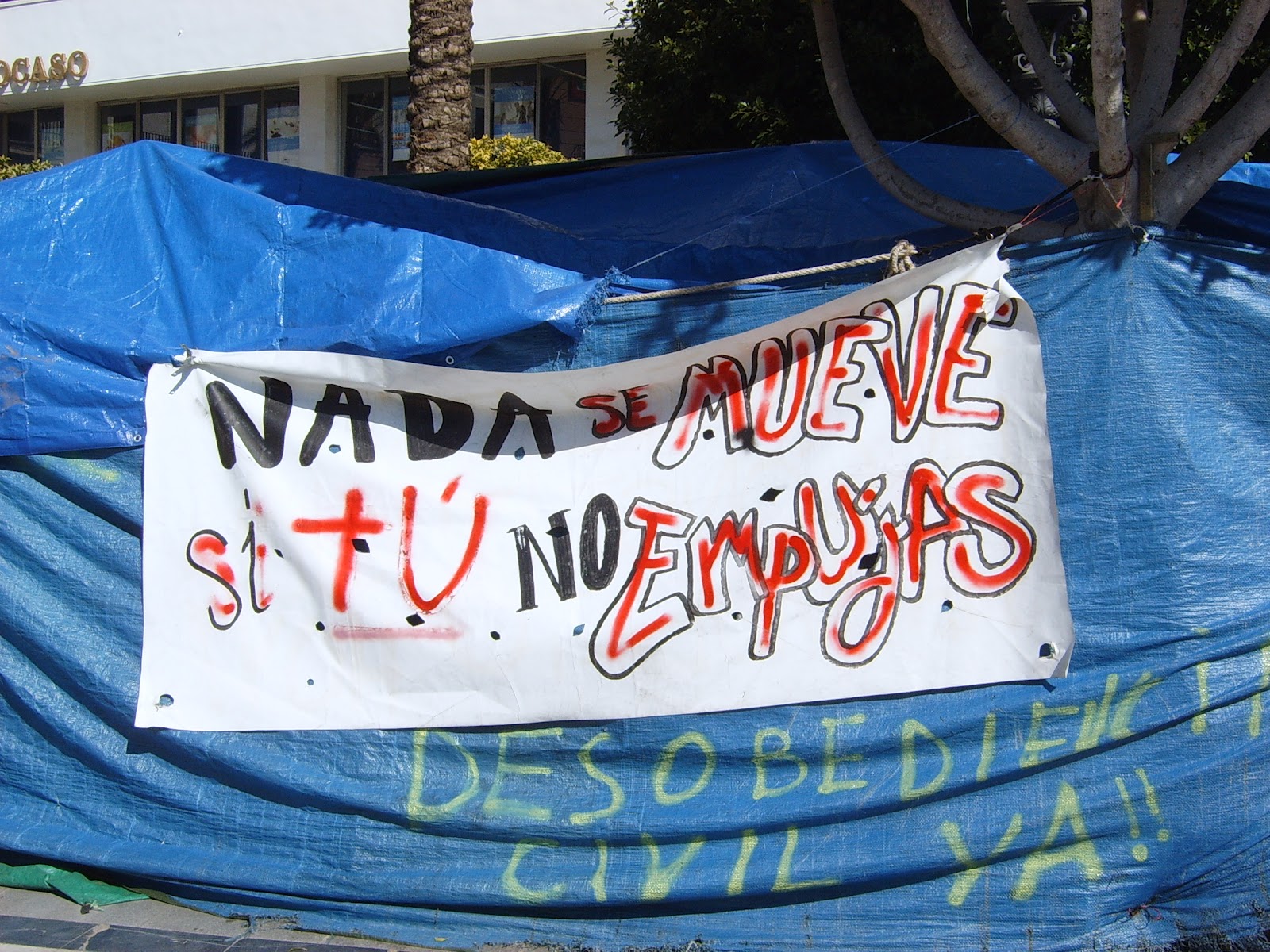
Sign on a tent of the Indignados encampment:  "Nothing moves unless you push.  Civil Disobedience Now."

Strikes in Spain are not like the strikes that have come to my attention in the United States.  The strikes I think of from here (both from being physically present when they took place, and from my studies of United States history when I was a graduate student) shut things down, or at least they try to.  There is often a lot of violence and confrontation associated with them, where the police (many times egged on by big capital) go in there with billy clubs, truncheons, rubber bullets and the like and try to break them up.  I also come up with the image of dockworkers on strike generally fighting pretty hard (and pretty violently) against the (violent) "forces of law and order."

The strikes in Spain, however...speaking only from what I personally know...are different.  For example, when I heard that Iberia Airlines planned to be on strike for an entire month last spring, I worried that I wouldn't be able to make it to the festival in Berlin.

The strike was settled before my flight date, but it turns out, I needn't have worried.  "Being on strike" meant that for one day of the week (Mondays), there were almost no flights.  The rest of the week, airplanes left on their normal schedule and on Mondays, I believe that some flights left with either their regular pilots or other, experienced personnel at the controls.

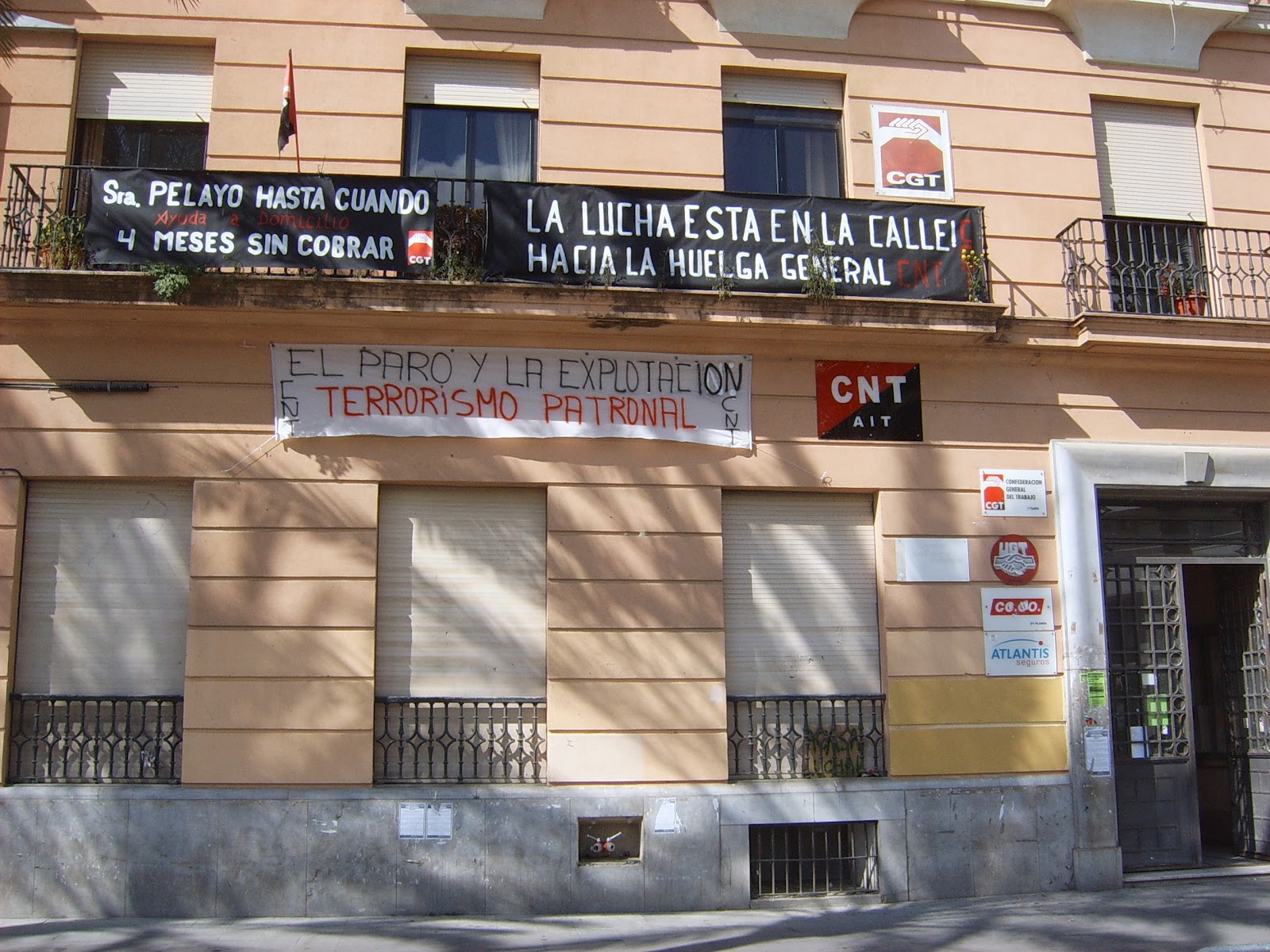
A union building (CGT) last winter.  See translation below.
Translation of signs on the CGT union building:  (on the left) "Ms. Pelayo [the mayor], when will it be?  No pay for four months."  and (on the right) "The struggle is in the street.  Join in the General Strike."  and (below, center) "Unemployment and exploitation:  paternalistic terrorism."

Then, there's the bus strike in Jerez, which has been going on for many months, perhaps even for over a year.  The strike doesn't mean that there are no buses.  It means that they come around less frequently.  It also means that the bus drivers march to city hall every week.  They have marched so often that they decided to liven things up with drummers.  And they have marched so frequently that the drummers have gotten to be pretty good.

Sorry that I have no photos of this.  I never had my still camera with me at the right time.

So what's with the strikes and demonstrations (and there are plenty more beyond the few I´ve mentioned)?

Well, in the case of the bus drivers, the city hasn't paid them their full wages for months and months and months and months.  In fact, last winter, the city didn't pay any of the city workers (except, I think, the administrators) for over three months.  THAT led to city workers camping out in tents in front of city hall.

One of the protestors' tents with City Hall in the background.

As for the Iberia pilots, I think they got paid, but their wages were drastically cut.

My point it that, although I understand things are different in the capitol city of Madrid, and the northern major city of Barcelona, in the south of Spain people are more civil.  They are more patient, if you will.  They are not out to ruin anyone's life, or business, or what have you.  I'll even point out that the degree of violent crime is much, much less in Spain (especially southern Spain) than in the United States.

A more civil, and more civilized, place...even if its financial sector and its administrators are messing things up  (current ones as well as the past ones...but for different reasons).

OUR NEXT POST will be about ... comparing flamenco with tap dance and Afro-Peruvian zapateo.