Monday, November 15, 2021


(This is a continuation of an article from our monthly newsletter.  If you want to read the whole article (with more photos), please sign up for the newsletter:  LINK
 
CONTINUED:  DR. KANG, NAGAR KIRTAN, and 100,000 PEOPLE

....  This celebration of Diwali includes a Nagar Kirtan - a parade which involves the chanting of prayers and, for the Sikhs, carrying their holy book, the Guru Granth, on a float through residential areas.

 Lots of people and decorated trucks in that parade.

This year, it's estimated that 100,000 people attended over the weekend.  The festivities began with fireworks on Friday night and ended with the Nagar Kirtan on Sunday.  The number 100,000 is smaller than usual due to covid;  more commonly, there will be up to 150,000 people who come not only from throughout California but also other parts of the USA and also abroad.


The Gurdwara at night, all decorated with lights.

I brought my mask (even though I'm fully vaccinated) but didn't need to use it as much as I expected because people do not crowd you and push and shove, even though so many are involved.  I watched all parts of the parade, from the Sikh motorcycle groups that led it, to the gurdwara elders and the float with the Guru Granth, to other floats and the martial arts group, to the truck parade...and of course, many, many people from the gurdwara.  Very impressive.

Here's one meal;  when you're feeding so many people, simple is best:  friend onions (just barely visible), rice, dahl, fried potatoes (spicy!), fried nan, and a sweet thing for desert.

Plus as is traditional for the Sikhs, everyone was offered free food throughout the celebration.  That's LOTS of meals served!!!


Sunday, July 30, 2017

Huevito, one of the stars of "Masters of Rhythm:

Our stars in Masters of Rhythm are such talented and charismatic people, I'm guessing you'd like to know more about them.  Huevito (Freddy Huevito Lobatón Beltrán), for example, was born in Lima, Peru's capitol - the youngest of eight children.  From the time he was a baby, he loved the cajón (cajón drum) and all of the music and dance of his Afro-Peruvian heritage.

Huevito in a pensive moment

When he was two years old, he would climb out of his cradle and sneak in to watch his father Mario Lobatón's performing group rehearse.  The group, Gente Morena de Pancho Fierro, was well-known and to Huevito's delight, they rehearsed in the family's living room.  He would sit on a cajón and watch, and then play the cajón himself during the breaks.

His father was known as one of the three or four best and most complete dancers of zapateo fancy footwork, an artwork that Huevito has since mastered.  In fact, Huevito has won so many prizes for his zapateo that now, he no longer completes and instead, often acts as judge in competitions.


Huevito's family is from the countryside to the south of Lima, in the coastal area.  Both parents were born in Chincha - his father from Hacienda San José and his mother from Regis (both towns close to el Carmen).  This area is one in which Afro-Peruvian culture is perhaps best preserved as a living tradition, and Huevito bears the stamp of a person steeped in his culture.

He began his professional career at age 11, although from the age of four, he used to perform in his father's group.  He, along with two of his older brothers, would get up and dance - especially zapateo!

About 12 years ago, Huevito was recruited by Gabriel Alegrías Afro-Peruvian Sextet, and he moved to New York to perform with them.  He lives in New Jersey and is the group's Afro-Peruvian soul, performing on the cajón, the cajita, the quijada de burro, and doing a bit of zapateo when the music calls for it.

playing cajón - Huevito in the center with Lalo Izquierdo (l) and Cotito (r)


Apart from his love of his culture and of rhythm in general, there is one thing Huevito wants the world to know about him:  about eight years ago, he kicked a serious drug habit and has never touched drugs since then.  He thinks it's important that other people who may have become involved in drugs know that it is possible to recover from this addiction.

And on that note, I say ¡olé! Huevito.  May you continue to give us those wonderful rhythms and continue to have a stellar career.

Monday, April 24, 2017

The Pariarch (Mahana) - a drama by and about Maoris in New Zealand

The Pariarch (Mahana), directed by Lee Tamahori, is a great story about family tensions, the conflict between an aging patriarch who has up until the movie opens ruled his family with love but what you could call extreme firmness (or an iron fist), and the young upstart, one of his grandsons.


You might think that a story about Maoris is so far removed from what "everyone else" experiences, or a story about a strict and authoritarian family patriarch is so far removed from "modern life" as to have no appeal and no relevance to the present.  Watching this film, I would respectfully disagree and think if you go to see it, you will as well.

The movie opens with a chase between two rival branches of a family as they rush to be the first ones to arrive at the funeral of a deceased elder.  It is gripping.  The lead car of each side of the clan tries to shove the other off the road, a narrow road with an even narrower bridge up ahead.

I won't tell you any more except that the entire movie was tight, full of suspense, and moving.  There were two places in which it let down a little - I "knew" that "he'd" fall off of that roof, and it was unclear to me at the end exactly how the love story between the grandmother and her former finacé would end - but not only did I really like this movie, I think it successfully shows that human emotions, no matter what the social circumstances, if profoundly felt can translate easily to all of us.

The director, Lee Tamahori, part Maori himself, is a New Zealand filmmaker who, among other things, has a James Bond movie to his credit.  He certainly knows how to handle plot and actors!  (Since there are six people listed as stars, I won't include their names here.)

And no more movie reviews for a while.  I need to see more movies first!

Sunday, April 16, 2017

Yemanjá: Wisdom from the African Heart of Brazil (documentary)

Another film that particularly caught my attention was the hour-long documentary, Yemanjá:  Wisdom from the African Heart of Brazil (dir.:  Donna Carole Roberts).  Filmed primarily in the province of Bahia, Brazil (whose principal city is Salvador) it tells the story of candomblé, a religion with strong roots in the Afro-Brazilian or Afro-indigenous community.  Candomblé itself is a religion which has been handed down from the African ancestors of its adherents. 


English Promo from Donna Carole Roberts on Vimeo.

The film de-mystifies candomblé, a religion which to me at least seems clearly related to voodoo and santería.  Core values include most importantly a profound respect for nature.  The orishá Yamanjá herself, for example, (orishá meaning deity, spirit, or saint - depending on who you listen to) is particularly associated with the sea.

The documentary also identifies other of the orishá and their several attributes (there is an orishá of plants and leaves, for example), but more importantly, it talks about the religion's strong interest in general ecological concerns, and the role of women.

Women are at the head of this religion.  Older women are especially valued, and in the film, the oldest of them all is the appealing spiritual leader/priestess Mãe Filhinha de Yemanjá-Ogunté, 109 years old when she was interviewed.

Combining fascinating interviews with shots of celebrations, both public and private, Yemanjá also includes images of  beautiful locations including a striking one where we see life-sized statues of the orishá set in the shallows of a popular lake. 

Relevant to those interested in ecology and the role of women, as well as in the African diaspora and Brazil, the film also explains that, with its large following, the adherents to candomblé would like to have their religion put on the same footing as Catholicism, at least in the city of Salvador.  Time will tell whether or not their wish is granted.

NOTE:  the film's narrator is Pulizer-prize winning author Alice Walker;  the cinematographer is Gerald Hoffman (husband of the director).

__________________
Next up:  The Patriarch (Mahana) directed by Lee Tamahori

Sunday, March 19, 2017

AfroLatinos: an Untaught History (documentary)

Another of the films that really stood out for me in this year's Pan African Film Festival was the hour-long AfroLatinos: an Untaught History (director:  Renzo Davia).  It's actually the summation of an entire series the Davia is creating - along with producer and co-writer Alicia Anabel Santos - about Afro-Latinos.

And in case you thought Dr. Louis Gates, Jr., was the one who "discovered" the topic of Afro-Latinos (or black Latinos) for North Americans, Davia started work on his film (as I did mine about Afro-Peruvians)  well before Gates' series came out.  That said, Gates series is not only excellent, but has also brought a huge audience to something that was, up until his first release, a small, niche audience of people interested in what seemed at the time an arcane topic.

I've had trouble finding the perfect trailer for AfroLatinos but in this one, the creators give an introduction to the project.  However, they are also asking for funding.


On the other hand, there is a good, 30-minute summation of the series on Vimeo.  However, I'm not allowed to imbed it;  but if you want to watch it on Vimeo, here's the link:

https://vimeo.com/151897541

It starts with the provocative question:  "How does history get erased?" and answers by saying that when you fail to tell people who they are and where they come from, you remove their identity and they disappear from history.

That was an important part of my thesis in my earlier documentary, A Zest for Life:  Afro-Peruvian Rhythms - that when talking about Latin jazz, if we don't acknowledge the contributions that Afro-Peruvians have made to it, even while using percussion instruments and rhythms that they created, we essentially negate their existence.

Not surprisingly, in view of my own interests, I found AfroLatinos to be a documentary on a timely topic.  It was also well and thoughtfully made, obviously representing a great deal of research and time spent filming some great interviews, great dances and music, great cultural celebrations.  If you have the opportunity, I do recommend that you go to see it, whether on television (which I think is the ultimate goal) or in a movie theater or on-line.
________________

Next up:  Yamanjá:  Wisdom from the African Heart of Brazil (dir. Donna Roberts).

Tuesday, March 14, 2017

Triangle: Going to America - a drama from Ethiopia

Staying with feature dramas that I saw in the recent Pan African Film Festival in Los Angeles, Triangle:  Going to America - Sost Meazen (directed by Theodros Teshome Kebede) was a moving tribute to not only Ethiopians but really all people who are forced to leave their country and try to make their was to a safe place.

With all the talk these days about immigrants and refugees, it is a very timely film.

Again, this is a drama, not a documentary, but it is solidly based in reality.  The reality is the perilous journey of those who left Ethiopia (but it could be almost any country) trying to get to the United States.  We don't know much about why these people wanted to leave, but we don't need to.  All we need to know is that there are hundreds of thousands, or in fact, millions, of people these days trying to leave the country of their birth because of various hardships and hoping to get to Western Europe or to the United States.

The film started with a group of about 20 people in a truck crossing a dessert.  We quickly learned that they had recently left their country and had paid money to be smuggled into another country.  (We later learned that the goal was the United States.)


As the film developed, the would-be immigrants encounter various serious problems;  serious enough so that by the end, only four actually make it into the United States.  The rest die in the process.

The filmmaker was there to present the film and he said that in fact, those are the statistics:  only about 20% of the many hundreds of thousands who flee actually live to make it to the country where they hope to live.

A sobering thought.

They die from dehydration and starvation.  They die from fierce sand storms in the desserts.  They die from being killed by smugglers.  The drown trying to cross the Mediterranean in flimsy boats.  They die for many reasons, but most of them do die.

In addition, we see that at every stage of the process, there are smugglers with their hands out, asking for thousands of dollars to help them along their journey.  And we see that in many cases, if they don't pay up, they are shot, or left in some inhospitable environment where they will die.

Of course, being a drama, there was a story - the story of the four individuals who, in this fictitious tale, actually made it into the United States.  There was a love angle.  There was strong friendship which helped the four successful ones complete their journey - and the friendship of one of the would-be immigrants willing to be killed to allow the others to achieve their goal.

The film was well acted, and had a real ring of authenticity to it.  It would be hard to leave this movie without feeling that we should be accepting far more, rather than far less, immigrants and refugees.

ADDENDUM:  The director has made a sequel to this movie called Triangle:  the Dream Realized.  Unfortunately, I did not like this sequel as much as the first one which I have reviewed here.

______________

Next up:  AfroLatinos, an Untold History (directed by Renzo Devia).

Thursday, March 9, 2017

Vaya, a drama from South Africa

Another really compelling drama that I saw at the Pan African Film Festival in Los Angeles was Vaya (directed by Akin Omòtoso, a filmmaker from Nigeria who also helped produce it).  It premiered at the Toronto International Film Festival in 2016 - a prestigious film festival, a worthy film.  Here's a TRAILER.


This movie wove together the story of three people from small towns in South Africa who came to Johannesburg by train to accomplish a task:  deliver a young child to her mother, find a job, bring the body of a dead father back to his home town for burial.  Each of these people encounters serious problems in Johannesburg, which obviously is a very, very tough city, especially for young and naive people from the countryside.

I didn't get to see more than 3/4s of this film because I had to leave to be present for the screening of my own work (Masters of Rhythm), and it is a tribute to the filmmaker that it was really, really hard to get up and walk out.  I still want to know how each story ends.

And it was obvious that each story would intersect.  This was skillfully done.

The characters were believable, the situations they got in were believable, it was well acted.

If you get the chance, go see it.  I certainly will - then I'll get to find out the ending!

(Next up:  Triangle:  Going to America)

Sunday, March 5, 2017

Wúlu, a drama from Mali

I recently attended the Pan African Film Festival in Los Angeles, where one of my documentaries was screening (Masters of Rhythm).  Among the great films that I saw there were dramas Wùlu (dir. Daouda Koulibaly), Vaya (dir. Akin Omotoso), and Triangle:  Going to America (dir. Sost Maezen).  The documentaries that stood out were AfroLatinos:   an Untold History (dir. Renzo Devia) and Yemanjá:  Wisdom from the African Heart of Brazil (dir. Donna Roberts).

And there were more (such as Chidren of the Mountains, etc.).

But first, let's look at Wùlu.  Directed by Daouda Coulibaly (who also wrote the script), it's a drama about the cocaine trade in Mali, which I believe is Coulibaly's home country.  It was released in the United States in October but I haven't seen it listed in any movie theaters;  that may be for the future.

This is a fast-paced crime drama based on the current situation in Mali.  In fact, a screen at the end of the movie says that the drug trade has ruined the country.  Not the first country to be ruined by it.

This is one of the few films in which I felt really sympathetic to a hero who is a drug runner.  He's a young man who fell into the drug trade and did quite well in it.  He doesn't end up so well, but I won't go there, in case you get a chance to see it.

It's well acted, and shot on location, obviously by someone who knows the location.  We are not talking about the curious and the exotic.  We are looking through the eyes of someone who has seen, and who knows.

I haven't been able to find any good trailers for this film.  There are a couple of clips on YouTube, but they really don't give much of an idea of the film.  One way or another,  if it comes to a theater near you, try to get to see it.  It's pretty powerful.

FYI:  the two clips can be viewed HERE (#1) and HERE (#2) [subtitles in this second one are hard to read], but as I noted above, neither one gives much of the flavor of the film.  However, something is better than nothing.


(Next up:  Vaya)

Saturday, March 26, 2016

Filmmaker in Search of Her Subject - visit to northern coastal Peru #3

part #3

It was also important to Luis Rocca that I understand that Afro-Peruvian culture, including its performance arts, has been heavily influenced by the indigenous cultures.  This is because of the close connection between blacks and indigenous peoples that dates back to the time of slavery, when blacks who managed to escape would live in communities in the jungle where they were in frequent and friendly contact with indigenous peoples. 

part of a collection of masks in the museum

Two other things of note from my time in Zaña:  I took a short, side trip to Cayaltí (in a jitney) to film a young man who performed a decima he had composed;  and I was surprised by how little African heritage still showed in the people of Afro-Peruvian descent in Zaña, unlike the population of el Carmen.  No one looked black!

the kid who recited his decima is wearing the orange shirt

The decima:  I only learned after the fact that the decima is a greatly respected poetic form used to comment on current events.  The word "decima" refers to the number of syllables per line.  The decimas are mostly composed on the spot, improvised;  but I have no doubt that the young kid had thought his out beforehand and them memorized it.

Finally, in Zaña, Luis Rocca took me into the home of a townsperson who was playing a game of skill with his neighbors.  It somewhat resembled horseshoes, and involved drinking a large amount of beer;  if you tossed and lost, you had to drink.  Lots of laughter;  especially when they insisted I try my hand at it.  I was NOT very good.

my hotel, the Don Juanito - more modest than where I stayed in el Carmen!

After we left, Luis Rocca explained that I was the first woman to be invited to watch this game.

a jitney in Zaña;  jitneys are very photogenic

 
cute towns-kids;  you've got to have cute towns-kids, right?
And so, having filmed many interesting things and seen things, some of which I would only later come to understand better, I took the bus cama back to Lima, filmed the documentary Masters of Rhythm with addendum, and returned to California.  A good trip. 
_________________
Eve A. Ma, a former university professor, lawyer, and director of a non-profit cultural organization, is the producer-director of two documentaries about Afro-Peruvians:  A Zest for Life and Masters of Rhythm with addendum.  Sign up for her newsletter to keep up with her work and get a special video:  www.PalominoPro-signup.com

Saturday, March 19, 2016

Filmmaker in Serach of Her Subject - visit to northern coastal Peru #2

part #2

But pushing on to Zaña:

From Chiclayo in Lambayeque, and the museum del Señor de Sipán, I continued on by taxi to Zaña where I was to meet with Luis Rocca of that town's Afro-Peruvian museum.  Luis Rocca has done incredible work with the museum, rescuing and recreating a large number of Afro-Peruvian musical instruments - especially drums made out of hollowed logs and a percussion instrument made from a gourd called a checo

Luis Rocca relaxing in a room in the museum

 I had met him in Lima, introduced by Nachi Bustamante, wife of percussionist Cotito. 

Zaña is a tiny town, on the scale of el Carmen.  The museum is also small, and seems to be run single-handedly by Luis Rocca.

a street in Zaña

He had a young man named Yim show me around;  he is from Zaña and is studying law in Germany but was home on vacation.  One of the things he showed me were a ruined convent and ruined churches...very large and impressive...which he explained had been ruined by "the flood."

Yim and his sister, who was one of the dancers of "Baila tierra."

I assumed "the flood" had happened a few years ago, but no, it had occurred in the 16th or 17th century, and the convent and churches have never been repaired.  It seems that Zaña was a major commercial center in the first part of the Spanish colonial period...but the flood put an end to that and the glorious buildings were never rebuilt.  Instead, a much smaller, more modest town was constructed higher up from the river and Chiclayo took over the commercial functions formerly enjoyed by Zaña.

part of the ruins of the convent

In the 3 or 4 days I spent in Zaña, Luis Rocca also had a young couple perform an old folk dance (which he encouraged me to film) called "Baila tierra."  It is reputedly the precursor of the immensely popular, current "national dance" of Peru, the Marinera.  This dance comes out of the Afro-Peruvian tradition.

City Hall rather dwarfs the buildings around it

_________________
Eve A. Ma, a former university professor, lawyer, and director of a non-profit cultural organization, is the producer-director of two documentaries about Afro-Peruvians:  A Zest for Life and Masters of Rhythm with addendum.  Sign up for her newsletter to keep up with her work and get a special video:  www.PalominoPro-signup.com

Tuesday, March 15, 2016

El flamenco - ¿está en peligro?

ENGLISH:  The series about my trip to Peru will continue on Saturday, Mar. 19.  ESPAÑOL:  La serie sobre mi viaje hasta el Perú va a continuar el sábado, 19 de marzo.

Estos meses, me dedicado a leer (muy despacito) un libro escrito por Juan Manuel Suarez Japón, que se llama Sinalo Calorró. Es una biografía de Manuel Morao y cuenta su vida en el flamenco basada en las conversaciones con él. Un aspecto muy interesante: en los años 1960 cuando todo el mundo pensaba que por fin el flamenco estaba floreciendo, Manuel Morao temió que iba a desaparecer. Yo pienso que Manuel Morao tenía razón. 

Manuel Morao

¿Pero quién es Manuel Morao?, ¿Por qué su opinión tiene tanto peso? y, ¿Por qué pensaba que el flamenco tradicional se encontraba en un momento de peligro?
 
Haz clic AQUÍ para escuchar a Manuel Morao que toca un solo de guitarra. Pero como tocar como solista no es tan normal en el flamenco, aquí el toca acompañando al cante de Antonio Mairena. AQUÍ 

Primero, quien es: desde los años 1960 hasta el principio de los 1990, fue uno de los guitarristas más emblemáticos del flamenco, y realizaba giras por toda Europa y América del Norte. Fue también el acompañante favorito de Antonio Mairena y Terremoto padre, al igual que de la Paquera, Chocolate, y muchos más. Además, ha influenciado mucho a su sobrino Moraito y su bis-sobrino, Diego del Morao.  


Manuel Morao con Antonio de la Malena

No solo eso, sino también ayudó a organizar y grabar antologías importantes del cante con Antonio Mairena y otros, en las que también fue guitarrista principal. Es uno de los guitarristas en la famosa serie de videos: Rito y Geografía del Cante.


En 1975, se retiró de muchas de las giras y las grabaciones (pero no de tocar) para volver a su ciudad natal, Jerez de la Frontera, dónde empezó a promocionar el flamenco. Organizaba y tocaba para una serie de eventos, los “Jueves Flamencos,” que dirigió por muchos años y a través de los cuales impulsaba las carreras de muchos de los profesionales de hoy en día (incluso Antonio de la Malena).

Pero eso no fue suficiente para Manuel Morao. En los años 1990, fundaba un negocio llamado “Gitanos de Jerez” que producía discos, videos, y espectáculos. De los espectáculos, uno de los más famosos fue “Gitanos: esa Forma de Vivir” en el que llevó a  22 artistas a un teatro en Broadway y a otros muchos alrededor del mundo. 
preparandonos para rodar una entrevista con Manuel Morao

 “Gitanos de Jerez” continuó con mucho éxito comercial hasta el principio de los años 2000.   Un poco antes empezó la mala suerte y Manuel Morao tuvo que parar de toca la guitarra, en parte, porqué empezó a tener un problema con los nervios de sus manos. 
¿Pero por qué ese hombre, desde los años 1960, pensaba que el flamenco estaba en una situación de peligro? Algo que trató de prevenir en toda su carrera profesional.  Según Manuel Morao, el flamenco en verdad no es nada menos que el cante de los gitanos, un cante que los no-gitanos también pueden realizar. Se puede llamar ese flamenco “el flamenco tradicional.”
preparando para grabar en otro sitio;  Manuel Morao está en el sofá

Centrándose en los gitanos, especialmente los gitanos de la baja Andalucía, Manuel Morao está totalmente convencido de que ese arte llega de los gitanos, la forma gitana de realizarlo es lo más puro, y es un arte integral a la herencia de la comunidad gitana. 
Para aprender más sobre el peligro que amenaza el flamenco tradicional os invito a mirar el documental que estamos creando “Flamenco: la tierra está viva”.  Consulta AQUÍ para ver su web.
 
_________________
Eva Ma (Eve A. Ma), antiguamente catedrática en la universidad, abogada, y directora de una organización cultural sin ánimo de lucro. Actualmente es la productora y directora de diversas películas incluso documentales sobre la música y los bailes del mundo, tal como Maestros del Ritmo con addendum. Para aprender más sobre su trabajo y obtener un video clip de una de sus producciones, apúntate aquí: www,PalominoPro-noticias.com

Saturday, March 12, 2016

Filmmaker in Search of Her Subject - visit to northern coastal Peru #1

part #1:

In addition to my two or so weeks in Lima, and my travels to the south, principally to the town of el Carmen, center of Afro-Peruvian culture, I went up north to visit the town of Zaña and the region around it.  This, like the rest of my time in Peru, was for the purpose of learning more about Afro-Peruvian culture, especially its music and dance, because Zaña is home to the important Afro-Peruvian museum.

Zaña is in the coastal region of Peru, near the small city of Lambayeque.  To get there, once again I took a bus-cama, leaving Lima in the late afternoon and arriving in Lambayeque in the morning of the following day.  From Lambayeque, I took a licensed cab to get to Zaña.


The museum is a re-creation in miniature of what archaeologists believe the pyramids looked like at the time the ruler was buried.  The "good stuff" is down in a deep basement, again representing the archaeological site.

On the way, however, I decided to make a stop at a place unrelated to my work:  the museum which houses most of the collection taken from the pyramid and tomb of el Señor de Sipan.

Who is this Señor de Sipan, you ask.

Glad you brought it up.  Peru, in addition to being the home of the Incas, was home to several other important civilizations.  One of these was the Sipán, or Moche, who actually pre-dated the Incas.  The civilization flourished from about 50-700AD, while the Inca rule only began in 1438, and ended less than 100 years later, in 1533.

The later rules of Sipán were mummified and buried in pyramids, and a few decades ago, in the later 1980s, a grouping of three of these pyramids were discovered and explored.

The pyramids now looks like a large, bare hills.  They were made of adobe bricks, and over the centuries, the rains have eaten away at it.  This is one of the reasons they were only recently discovered.


replica of one of the many adornments found on the mummy of the Señor de Sipán:  gold necklace and earrings with owl heads;  the owl represents the afterlife

Excavations of the second to largest of these pyramids revealed the elaborate tomb and mummy of what is presumed to have been a great ruler, now referred to as el Señor de Sipán (the Lord of Sipán).

The museum contains a replica of the mummy of the ruler, his wife, and someone important who was buried under him (possibly his father) while the actual remains have been left in the pyramid (which I didn't have time to visit).  The display in the museum shows what the burial chamber looks like, and has many of the fabulous gold, silver, turquoise, and other jewelry with which he and his wife were adorned.

Of course, a couple of guards, dogs, and other former beings were buried along with them, presumably to wait on them, keep them company in the afterlife, and so forth.

_________________
Eve A. Ma, a former university professor, lawyer, and director of a non-profit cultural organization, is the producer-director of two documentaries about Afro-Peruvians:  A Zest for Life and Masters of Rhythm with addendum.  Sign up for her newsletter to keep up with her work and get a special video:  www.PalominoPro-signup.com

Saturday, March 5, 2016

Is the sky falling? Or is flamenco in danger of dying?

Is the sky falling?  Or is flamenco in danger of dying?

(We will continue next week with the series on my trip to Peru.)


Over the past several months, I've slowly been reading Sinalo Calorró by Juan Manuel Suarez Japón, a biography of Manuel Morao which traces Manuel Morao's life in flamenco through the author's conversations with him.  One fascinating thing is that, back in the 1960s when everyone else thought flamenco was flourishing, Manuel Morao felt it was in danger of disappearing.  I think Manuel Morao was right.


Manuel Morao in front of the Plaza de Toros,
where the Jueves Flamencos were held

But who is Manuel Morao, why does his opinion carry any weight, and why did he think traditional flamenco was in trouble?

Click on LINK to hear Manuel Morao playing solo guitar.  And since playing solo isn't usual, here he is accompanying the singing - cante - of Antonio Mairena.  LINK

First, who is he:  from the 1960s through the early 1990s, he was one of the pre-eminent flamenco guitarists, and toured throughout Europe and North America.  He was also the favorite accompanist of Antonio Mairena and Terremoto the elder, to say nothing of la Paquiera, Chocolate, and many others.  Furthermore, he greatly influenced his guitarist nephew, Moraito, plus his guitarist grand-nephew, Diego del Morao.


Manuel Morao with Antonio de la Malena

He helped organize and record major anthologies with Antonio Mairena and others, in which he was also principal guitarist.  He is one of the main guitarists in the famous video series, Rito y Geografía del Cante.

In the mid-1970s, he stepped back from much of his touring and most of his recording to return to his birthplace, Jerez de la Frontera, where he became a major promoter of flamenco.  He organized - and played for - a weekly series of extremely popular events in Jerez called "Jueves Flamencos" (Flamenco Thursdays), which he ran for years and which launched the careers of many of the famous performers of today (including that of Antonio de la Malena).

That, however, was not enough.  In the early 1990s, he started a company called Gitanos de Jerez (Gypsies of Jerez) which produced music albums, DVDs, and major shows.  The most famous show was one in which he brought 22 flamenco artists to play on Broadway in something called "Gitanos:  Esa Forma de Vivir" ("Gypsy Passion").


preparing to film interview with Manuel Morao


Gitanos de Jerez continued in operation, very successfully, until the early 2000s.  By this time, Manuel Morao had stopped playing the guitar, partly because he had developed a nerve problem in his hands.

But why did this man believe, even back in the 1960s, that flamenco was in danger of disappearing - something he spent his entire life and career trying to prevent?  For Manuel Morao, "flamenco" was another word for "el cante de los gitanos," which literally means "the singing of the Gypsies [of Andalucía in southern Spain]" but practically, means traditional flamenco.


preparing to film in another location;  Manuel Morao is on the sofa

His emphasis on gitanos - the Gypsies of Andalucía - does not mean he believes only gitanos can sing and perform flamenco;  but he does fervently believe that the art comes from them, they are its purest proponents, and the art continues to be part of their heritage,  an integral part of their community.

To learn the danger in which traditional flamenco finds itself, you will need to watch the documentary we are making, Flamenco:  the Land Is Still Fertile (Flamenco:  la tierra está viva).  Go HERE to check out its web site.

_________________

Eve A. Ma, a former university professor, lawyer, and director of a non-profit cultural organization, is the producer-director of several documentaries about world music and dance, including A Zest for LifeAfro-Peruvian Rhythms Of Beauty & Deities:  Music & Dance of India, and Masters of Rhythm with addendum.  Sign up for her newsletter to keep up with her work and get a special video:  www.PalominoPro-signup.com

Tuesday, March 1, 2016

Filmmaker in Search of Her Subject - visit to southern coastal Peru #3

part 3:

As promised:


Here is a video about the "hatajos" with an explanation of them.

When it came time to leave el Carmen, I encountered the problem of paying my bill at the lovely bed and breakfast.  The owner needed cash.  I didn’t have enough cash – and the ATM in the local grocery store wouldn’t accept my (foreign) ATM card.

SO – we went to Chincha for lunch to allow me to visit a bank with an ATM that would accept my card.  To get to Chincha, we took a local bus – crowded, bumpy, but friendly.   It made me feel a little less like an outsider, even though in fact I was one.

After I paid my bill and left el Carmen, I went to the town of San Luis de Cañete for a few hours to film the kids that my friend (and star of my documentary) Lalo Izquierdo teaches in a cultural center he helps operate.  San Luis de Cañete is another center of Afro-Peruvian culture.  Unfortunately, I wasn't able to take any photos in San Luis:  too little light, and I was busy filming.

Because I arrived several hours late, we went straight to the place where I was to film, which was where the kids were rehearsing for THEIR “hatajos.”  The rehearsal space was in a building with no roof! 

The kids were great, but later, to get signatures giving me permission to use what I had shot, I had to pay the parents.  I was not expecting this and it was not in my budget.  As a result,   I’ve only been able to pay to use a very small number of these kids.   What a shame!

a jitney just like the one I took in San Luis de Cañete

In San Luis de Cañete, I also had my first ride in a jitney (a covered, three-wheeled motorcycle that is used as a taxi in many Peruvian towns).  Kind of fun, but I’m not sure you’d stay very dry if it were raining.   And after the filming, we had dinner in a little, local restaurant beside the Pan-American highway, hanging out there until my bus back to Lima arrived.

Once again, another bus-cama.

My last article about my Peruvian trip, will cover my trip to the town of Zaña in the north, with a brief stop at the museum of the Señor del Sipán, dedicated to displaying some impressive artifacts obtained from the pyramids of one of Peru’s ancient civilizations.

_________________
Eve A. Ma, a former university professor, lawyer, and director of a non-profit cultural organization, is the producer-director of two documentaries about Afro-Peruvians:  A Zest for Life and Masters of Rhythm with addendum.  Sign up for her newsletter to keep up with her work and get a special video:  www.PalominoPro-signup.com

Saturday, February 27, 2016

Filmmaker in Search of Her Subject - visit to southern coastal Peru #2

part 2

As I’ve mentioned, el Carmen (and indeed, much of the region of Chincha) is known as a center of Afro-Peruvian culture.  El Carmen and the nearby towns of San José, Guayabo and others maintain a very old Afro-Peruvian tradition called the “hatajos de negritos.” 

This is a kind of performance and procession that is part of the Christmas celebration, and also the celebration of the Virgin of el Carmen, whose special day is December 28.  I’ll add a video of the celebration later on in this article. 


the front drive to the bed and breakfast:  Huaranjapo


But first, I should tell you about the bed and breakfast where I stayed.  It is on an estate that is a five minute walk from town.  There is a lovely bungalow, and a couple of small, outlying buildings that serve as additional guest rooms when the bungalow is full.  There is a swimming pool.  There is a patio.  There are a couple of friendly dogs;  and a nice couple that live in a tiny house near the front gate and act as caretakers.  There is a small avocado orchard;  a small guava orchard;  a few banana trees;  a large lawn;  lots of flowers…in sum, a lovely place.  And yes, it has an internet connection.


Amerigo and his wife - the caretakers - in the back veranda of the main guest house

The only downside that I encountered was – mosquitoes.  Bring insect repellent.  Seriously.

one side of the main guest house

The owner, Edith Maldonado, is friendly and very well informed about Afro-Peruvian culture.  She is a pillar (and former board member) of one of the two cultural organizations in el Carmen.  We had been corresponding for months, and she introduced me to people in the town who helped me with my work.


Edith Maldonado (left) with board president Emely Villegas (right) in the cultural center
I was there to film the town (easy – it is a very small town) and the setting (lots of cotton fields, a river that I never got to, and other small towns nearby – I saw the town of San José very briefly).  I was also there to make contact with at least one cultural center;  and to film the rehearsals for the “hatajos de negritos.”

a street in the town - with the only two-storey building

the church dominates the town

there are lots of murals on the walls

The residents of the town are people of very modest means – so modest that I felt a little uncomfortable coming from the lovely bed and breakfast where I was staying to talk to people many of whose homes didn’t even have running water.

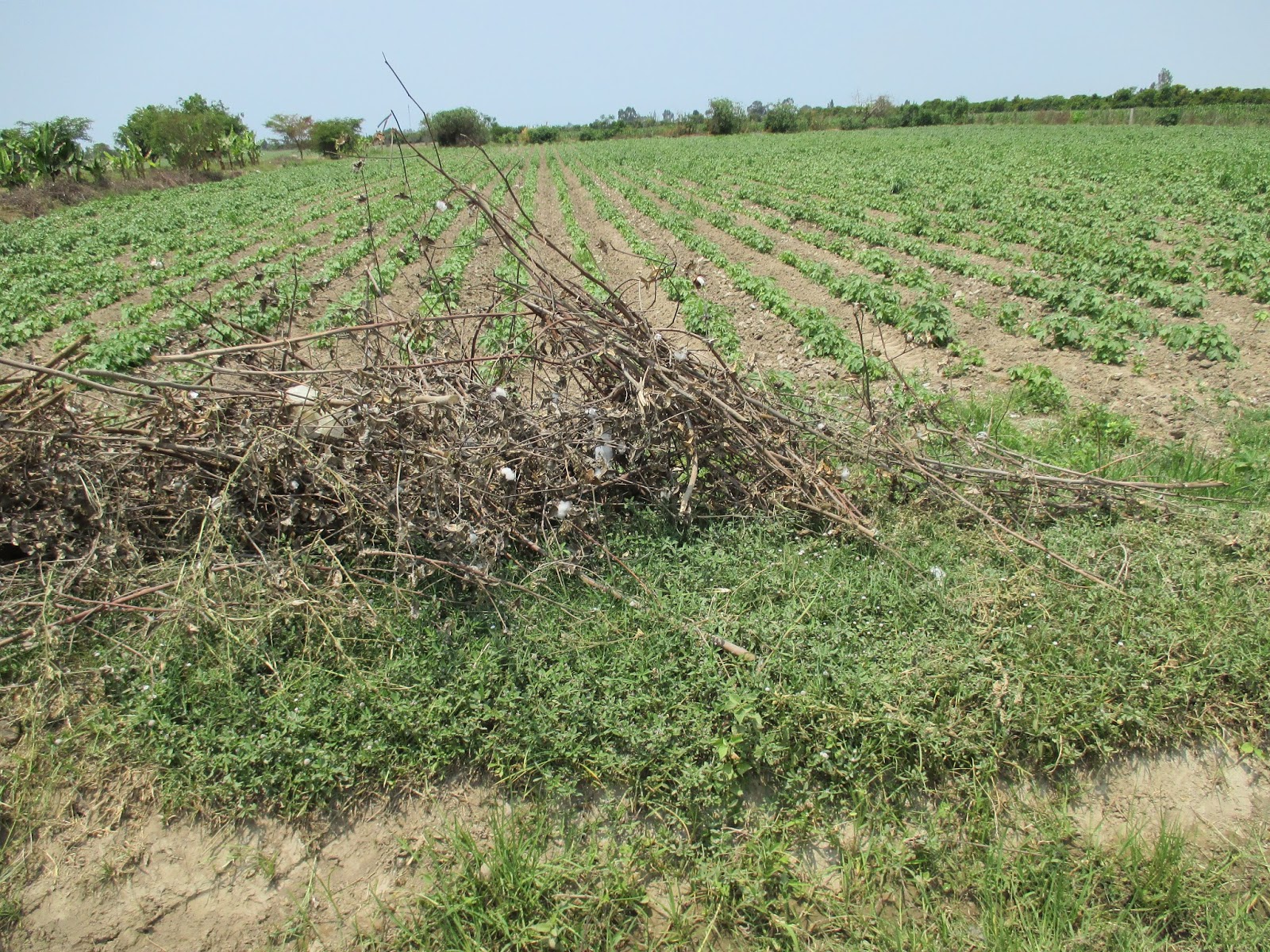
Although most own their own farmland, many find work outside of town in larger places like Chincha.  This is partly because a very few years ago, the Peruvian government signed a trade deal with China that has brought Chinese cotton into the country at a lower price than local cotton.  Some townspeople would like to change over to growing cacao, for which there is still a good market, but it takes three years for the cacao plants to mature enough to bring in a serious crop, and the townspeople don’t have the wherewithal to wait for three years with no farming income.

a cotton field outside of town

My filming of the town and of one rehearsal of the “hatajos” went pretty smoothly, although getting the required signature saying we’d filmed with permission turned out to be a bit sticky (but in the end, we got what I needed).   We also went to the home where the second group of “hatajos” rehearses, but they didn’t want to be filmed. 

house of Margarita Córdova where one set of "hatajos" rehearsed

I have since learned that “everyone” comes to el Carmen to see the “hatajos” – and many people have filmed them – so I guess people feel that they should get paid and that they are being somewhat taken advantage of.  I can sympathize with this.

I'll give you a video with clips of the "hatajos" and an explanation of them in the next post.

_________________
Eve A. Ma, a former university professor, lawyer, and director of a non-profit cultural organization, is the producer-director of two documentaries about Afro-Peruvians:  A Zest for Life and Masters of Rhythm with addendum.  Sign up for her newsletter to keep up with her work and get a special video:  www.PalominoPro-signup.com

Tuesday, February 23, 2016

Filmmaker in Search of Her Subject - visit to southern coastal Peru #1

In December of 2014, I spent about a month in Peru, shooting footage for documentaries about Afro-Peruvians.  About half of that time I was in Lima (see “Filmmaker in Search of Her Subject - My Trip to Lima, Peru).  The other half I spent in the coastal area to the north and south of Lima, in small towns known for being treasure troves of Afro-Peruvian culture.

No, the Andes Mountains and the ruins at Machu Picchu were not on my agenda;  I was working.

Lima is on the coast, about halfway down.  I was heading south.


In the south, I visited the town of el Carmen;  and in the north, the town of Zaña.  In this article, I’ll talk about going to the south, to el Carmen, and then San Luis de Cañete.

To get to el Carmen, I took a bus-cama (bus with beds).  A friend in Lima helped me purchase the ticket, which was a good thing because I certainly didn’t know my way around well enough to do so easily on my own.

The buses were overnight buses;  you could choose to leave any time from around 5pm up until around 8pm, all of which would put me at my destination in the morning.  A long trip.

I believe that somewhere on that bus-cama there were seats that could be stretched out into beds, but most passengers, myself included, had a seat in an area in which you could recline the seat somewhat, but certainly not enough to make it into a bed.

El Carmen is a little below the center of this map.

Dinner and breakfast were provided on the buses.  These meals were not anything memorable, so I’ll pass over them.  If you take one of these trips, consider bringing along your own food.

We traveled along the Pan-American highway which in most places is a two-lane highway with streets and roads crossing it. 

I had a window seat.  At the beginning of the trip, since the sun was up, I could look out.  For the first hour, what I saw was seemingly endless, poorer suburbs of Lima.  Then, we got to the countryside.

The river-valleys are full of small farms growing cotton and other crops.

The countryside was mostly dessert, with the ocean off on one side in the distance.   There were squatters’ shacks along part of this dessert area.  Then, almost without warning, we’d come to a lush river valley:  green, and full of trees, small farms, and towns.  I learned that Peru had had land-reform about 30 years ago, so that where once there were huge estates worked by day laborers or tenant farmers, now most of the farmers own their own land.

After a couple of hours on the bus-cama, it got dark.  Someone in corporate offices had had the unfortunate idea of installing a TV in the bus-camas and for some reason, the volume was turned up pretty loud.  It was impossible to ignore this machine once you couldn’t look out the window any more;  but finally, around 10:30pm, it went off. 

In the morning, I got off the bus-cama in a town called Chincha, and according to instructions (from the person who owned the bed and breakfast where I would stay), I took a licensed taxi to el Carmen.  The ride took about 15 minutes.

_________________
Eve A. Ma, a former university professor, lawyer, and director of a non-profit cultural organization, is the producer-director of two documentaries about Afro-Peruvians:  A Zest for Life and Masters of Rhythm with addendum.  Sign up for her newsletter to keep up with her work and get a special video:  www.PalominoPro-signup.com